
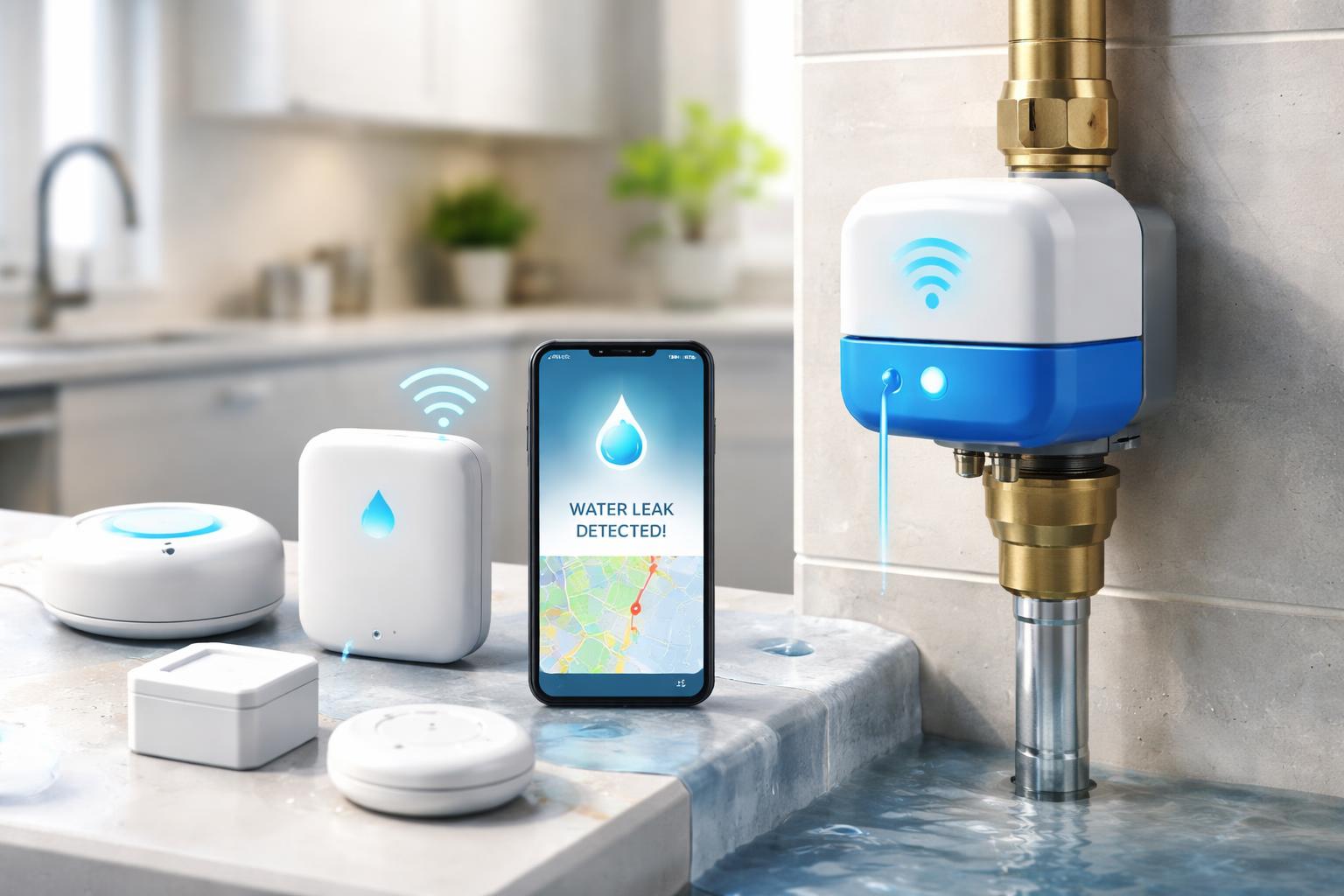
The Best Smart Water Leak Detectors & Shut-Off Valves for Homeowners in 2026
Water damage is the most expensive covered claim in homeowner's insurance—the Insurance Information Institute reports that water damage and freezing account for nearly 29% of all claims filed, with the average claim exceeding $11,000. Yet most homeowners don't know they have a leak until catastrophic damage forces them to call a plumber.
The market has shifted dramatically since 2024. Moen Smart Water Shutoff and Phyn Plus Smart Water Monitor remain the gold standard for whole-home protection, but what's changed is that the smart water leak detection market is now at $151 million (2024) and projected to hit $222.47 million by 2033—driven primarily by insurance incentive programs and Matter 2.0 adoption finally standardizing how these devices talk to each other.
Two Different Approaches to Water Protection—And Why You Might Need Both
Spot detectors are like smoke alarms for water. Small, battery-powered, placed under sinks and near appliances, they catch specific leaks in high-risk zones. Whole-home monitors are different: they learn your home's water fingerprint and flag anomalies (a constant low drip, an unexpected 3 AM surge) that humans would miss for weeks. The best strategy for most homes? Start with spot detectors if you're budget-conscious or renting, but whole-home monitoring pays for itself the first time it catches a slow leak before it becomes mold.
Why This Matters Right Now
Insurance companies are now offering discounts for installed smart water systems. Over 60% of users report immediate savings or premium reductions. If you're paying $1,200/year for homeowner's insurance, even a 5% credit ($60/year) covers the basic spot detectors in under a year. But the real savings come from the LeakSmart system (5-second auto shutoff) or Phyn Plus preventing a $15,000 basement flood while you're out of town.
The Product Breakdown
For Maximum Coverage: Moen Smart Water Shutoff
This is the "set and forget" system. Installed on your main water line, it monitors flow 24/7 using MicroLeak Technology that detects continuous flow as low as one drop per minute. Within weeks, it learns your home's baseline—when your 6-year-old showers vs. when the washing machine runs—and flags deviations that point to hidden leaks in walls or under floors.
How this saves you money specifically: A slow toilet leak (the most common hidden leak) wastes 20+ gallons daily. Undetected for 6 months, that's 3,600 gallons you're paying for. This system catches it in days. The app shows real-time water usage, so you can identify the exact fixture.
Key practical features:
- Automatic shutoff within seconds or manual app control from anywhere
- Works with existing Moen Smart Water Detectors for targeted alerts (you'll know "water detected under kitchen sink" vs. generic "leak found")
- Requires professional installation (cutting the main line); budget $150-300 for a plumber
- Wi-Fi connected, integrates with Alexa and Google Home
Install scenario: If your home is over 20 years old, has had plumbing repairs before, or you're in a cold climate (frozen pipes), this is the baseline protection tier.
For Advanced Detection: Phyn Plus Smart Water Monitor
Phyn analyzes water pressure 240 times per second—essentially eavesdropping on your pipes at a molecular level. It's built for homeowners who want to understand \*why\* a leak happened, not just that it did. The AI learned from 5 million+ homes and can distinguish between a pinhole leak, a burst fitting, and a valve issue based on pressure signature alone.
Real-world use case: A user reported their Phyn Plus identified a failed water line connection 2 days before it would've burst inside a wall. They had it repaired for $600. Without detection, they estimated $8,000+ in drywall and mold remediation. The device costs $800; ROI was instant.
The trade-off: More expensive upfront, requires professional installation, and the learning curve is steeper—you're looking at 2-3 weeks of baseline collection before it's fully effective.
Best for: New construction verification, luxury homes, or situations where you've already had a water claim and want zero risk tolerance.
The Budget-Conscious Entry Point: Moen Smart Water Detector
Place these under your sink, near the water heater, behind the toilet, and in the basement. Moen Smart Water Detector is designed specifically for the places leaks actually start. They also monitor temperature and humidity—which matters more than you'd think. If humidity spikes without a water alarm triggering, you've got a slow, hidden drip somewhere (common in concrete slabs).
Practical advantage: Battery lasts 5+ years, costs $30-50 each, no installation required. Most effective when you place 4-6 around your home. Total cost: $150-300 for comprehensive spot coverage.
Limitation: They only catch water if it physically reaches the detector. A leak inside a wall won't be detected until it travels far enough to drip or surface—by which point damage may have begun.
Speed-First Option: LeakSmart Leak Detector & Shutoff Valve System
LeakSmart's 5-second shutoff is the fastest in the industry. Wireless sensors throughout your home send signals to the main shutoff valve via Z-Wave and proprietary protocols. The system has battery backup, so even if Wi-Fi dies (typical during storms—when leaks happen most), it still operates autonomously.
Specific advantage: Z-Wave communication is more reliable than Wi-Fi in emergencies. Wi-Fi can drop during power surges, but Z-Wave mesh networking keeps the signal alive. Insurance underwriters recognize this—some offer higher discounts for Z-Wave systems because they're more likely to actually function during failure scenarios.
Cost consideration: Hybrid model—sensors + central hub + shutoff valve costs $800-1,200 installed. Cheaper than Phyn Plus, faster than Moen.
For Renters and Non-Invasive Monitoring: StreamLabs Smart Water Monitor
StreamLabs clamps onto your main water line without cutting—critical if you rent or don't want permanent modifications. Uses ultrasonic sensors to read flow through the pipe wall itself. No professional installation needed for most homes.
What it's good for: Water consumption tracking and leak alerts based on abnormal usage patterns. Real-time dashboard showing which appliances use water, pinpointing inefficiencies.
What it's not: A shutoff system. It's a sensor + alert system. You still have to manually turn off water or pair it with a separate smart valve. Many StreamLabs users pair it with a standard ball valve controlled via Alexa routine for semi-automatic protection.
The 2024-2025 Market Shift You Should Know About
Matter 2.0 adoption is forcing compatibility. In 2024, you had to choose an ecosystem: Alexa-native, Google Home, or SmartThings. By 2026, all major manufacturers support Matter 2.0 standard, meaning your Moen device talks to your Google Home just as easily as your Philips Hue lights. This removes a major friction point—you can now buy the best device regardless of your existing ecosystem.
AI-based diagnostics are standard now. Every new whole-home monitor launched in 2025 includes machine learning for pressure analysis. This trend is driven by insurance companies pushing for better diagnostics (not just "yes/no leak detected" but "type of leak, location estimate, urgency level"). It's not a luxury—it's becoming expected.
Wireless adoption is 62%+ of new installs. The shift away from wired systems is accelerating because wireless means easier DIY installation and easier relocation when you move. This benefits both the LeakSmart and StreamLabs approach.
Decision Matrix: Which System Fits Your Home?
| Your Situation | Best Choice | Why | Cost Range |
|---|---|---|---|
| Home over 25 years old, no recent plumbing work | Moen Smart Water Shutoff | Catches hidden leaks in aging systems before they burst. Pays for itself in insurance discount. | $800-1,100 |
| Had a water claim in last 10 years | Phyn Plus Smart Water Monitor | Highest sensitivity, catches micro-leaks, insurance looks favorably on proactive systems. | $900-1,300 |
| Renting or want no permanent changes | StreamLabs Smart Water Monitor | Non-invasive clamp-on, tracks consumption, portable. | $200-350 |
| Want fastest shutoff + Z-Wave reliability | LeakSmart Leak Detector & Valve | 5-second shutoff, battery backup, mesh network survives Wi-Fi failure. | $800-1,200 |
| Budget-first, new construction, no hidden risks | Moen Smart Water Detectors (4-6 units) | Low cost, long battery life, catches water at known risk zones. | $120-300 |
Installation Reality Check
If your shutoff valve is accessible and you have a clean main water line: Professional installation is 2-3 hours, costs $150-300. Straightforward job, most plumbers have done 100+.
If your main line is in a crawlspace, buried, or has old copper fittings: Budget $400-600 and allow for complications. Some homes need new fittings or adapters that cost extra.
Spot detectors: Genuinely DIY. Peel, stick, connect to Wi-Fi. 5 minutes per unit.
StreamLabs monitor: DIY if you have access to the main line. Clamp placement and calibration take 30 minutes. Most homeowners can handle it, but you need a wrench and basic comfort with plumbing areas.
What Actually Matters for Insurance Discounts
Here's what insurers look for (in order of impact):
- Automatic shutoff capability — systems that stop water flow without human intervention score highest
- Continuous monitoring — 24/7 operation with real-time alerts (not just spot detectors you manually check)
- Backup power — battery backup or Z-Wave that works during outages (critical for storm season)
- Professional installation record — some insurers want proof of professional install, not DIY
- Brand reputation — Moen, Phyn, LeakSmart are well-established; newer brands may not qualify
Contact your insurer with the system model before buying—they can quote your discount upfront. Average discount: 5-15% of annual premium.
The Real Gotchas Nobody Mentions
Power outage behavior: Test what your system does without power. Some shutoff valves fail-safe (stay open, allowing water through if power dies). Others fail-closed (no water at all). Know which one you have. For Moen and Phyn, both have battery backup for the valve itself, but for alert functionality you need Wi-Fi. LeakSmart's Z-Wave keeps working.
Hard water and mineral buildup: In high-mineral areas, flow sensors get fouled within 2-3 years. Request service intervals when you buy. Phyn Plus handles this better than older Moen versions due to ultrasonic vs. mechanical sensors.
False alarms are possible: A sudden pressure drop (someone turning on a hose outside, a pressure regulator adjustment) can trigger alerts. Most systems allow you to set sensitivity thresholds after learning your patterns, but initial setup can be noisy. Plan for a 2-week adjustment period where you might get 3-5 false alarms as the system calibrates.
The slowest leaks are the hardest to catch: A leak that loses 1 gallon per day is nearly impossible for any system to reliably detect because it's within normal variance. It takes 1,000 days to lose 1,000 gallons. These are rare and mostly affect users in very specific situations (slab leaks on irrigation lines). Spot detectors are useless here; only whole-home monitors have a chance, and even then it's marginal.
Final Verdict
If your home is built before 2000 or you've ever had a water claim: start with a whole-home system. The ROI is clearest when you have the most risk.
If you're new to smart home devices and uncertain: begin with 4-6 Moen Smart Water Detectors under your sinks, behind toilets, and near the water heater ($150-300 total). You'll immediately know where leaks start in your home. Upgrade to a shutoff system later when you're more confident.
If you rent or move frequently: StreamLabs non-invasive monitor is your practical choice. You get usage insights and leak alerts without modifying the property.
If you prioritize speed and reliability above all else: LeakSmart's 5-second shutoff and Z-Wave mesh network eliminates Wi-Fi failure risk—useful in storm-prone regions.
Water damage is expensive enough that even the most comprehensive system pays for itself in prevented losses. The decision isn't whether to buy one—it's which type of protection matches your home's age, your risk tolerance, and your insurance provider's incentives.