
Best Smart Sleep Trackers That Work Without Wearing Anything
Understanding Contactless Sleep Monitoring
If you find yourself tossing and turning or waking up feeling exhausted despite spending eight hours in bed, you might wonder what is actually happening while you sleep. Most people assume they need a smartwatch or an uncomfortable ring to track their rest, but you can gather incredibly detailed data without wearing a single thing on your body.
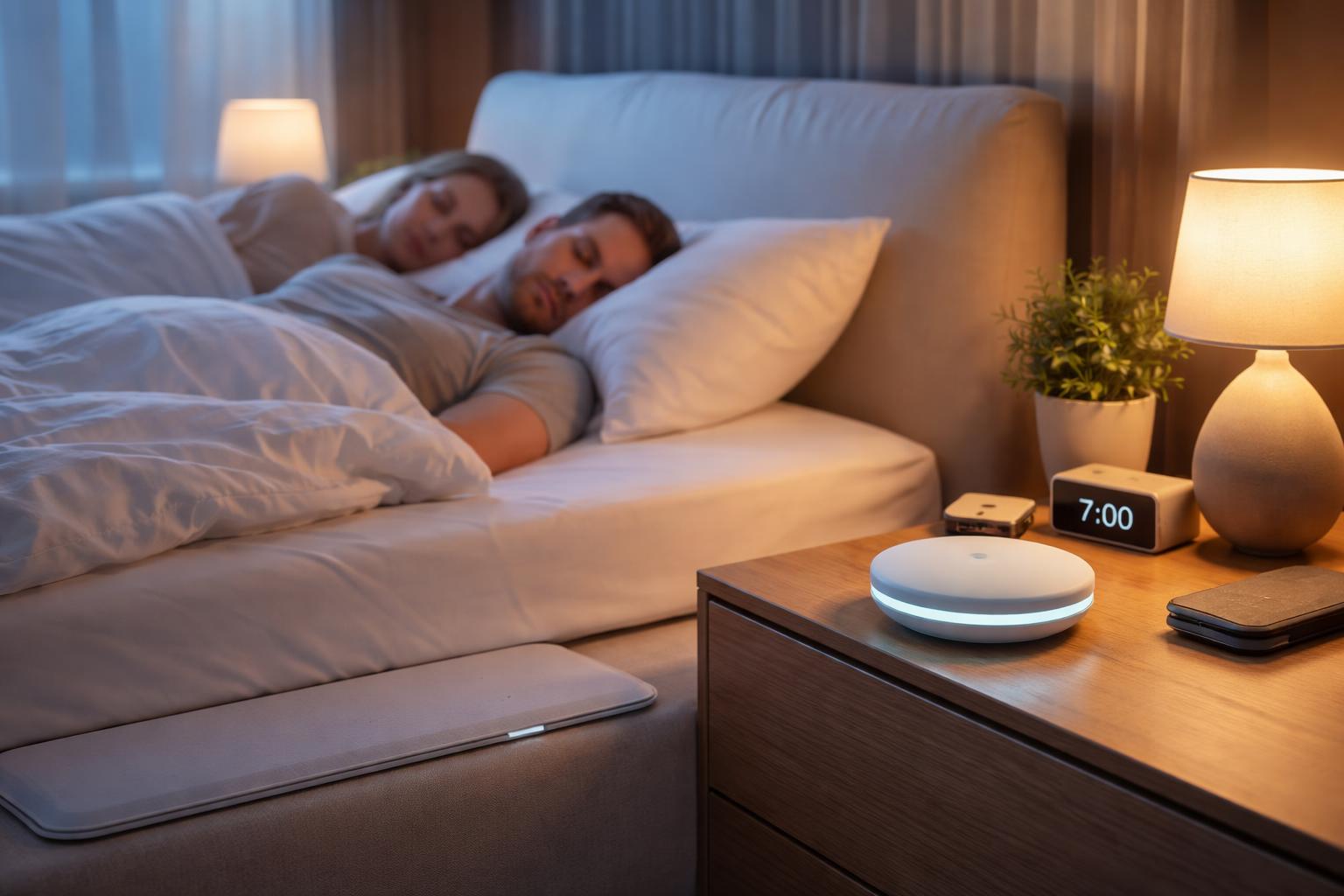
Contactless sleep trackers use sensors placed under your mattress or on your nightstand to detect tiny vibrations, like your heartbeat and breathing, through the mattress itself. They offer a passive way to monitor your recovery and sleep architecture without the irritation of a device strapped to your wrist.
Withings Sleep Analyzer
The Withings Sleep Analyzer is best for people who want a "set it and forget it" experience that lives permanently under their mattress. It slides right under your mattress pad, meaning you never have to remember to charge it or put it on before bed.
Real-world experience: The biggest mistake users make is placing it too close to the edge of the bed or using a mattress that is too thick. If your mattress is memory foam over 15 inches thick, the sensor might struggle to pick up your pulse accurately. Always ensure the mat is positioned directly under your chest area for the most reliable results.
Limitation: Because it sits under the mattress, it cannot track your movement if you spend time reading in bed before you actually fall asleep, occasionally leading to false "sleep onset" data.
Key Features
- Clinical-grade sleep apnea detection.
- Measures heart rate, breathing rate, and movement.
- Full, detailed reports delivered to the dedicated smartphone app.
Google Nest Hub (2nd Gen)
The Google Nest Hub (2nd Gen) is best for those who want a visual dashboard that displays sleep summaries the moment they wake up. It uses a low-energy radar technology called Soli on your nightstand to monitor your sleep without any physical contact.
Real-world experience: Because this device uses radar, it is sensitive to placement. You need to position the display at the same height as your mattress and angled toward your torso. If you share a bed, the radar is impressively smart at distinguishing who is who, but it works best if you are the one sleeping closest to the device.
Limitation: It requires your bedroom to be kept relatively clear of clutter between the nightstand and the bed, as any stray objects or even a heavy blanket draped over the edge can interfere with the radar's precision.
Emfit QS
The Emfit QS is best for serious data enthusiasts who want professional-grade metrics without the privacy concerns of cloud-based voice assistants. It provides some of the most granular data available, including Heart Rate Variability (HRV), which is a top-tier indicator of how well your body is recovering from stress.
Real-world experience: This tracker is much more sensitive than consumer-grade alternatives, often picking up restlessness that you might not even realize you have. One nuance to keep in mind is the "ballistocardiography" technology; it works best on firm or medium-firm mattresses and can lose accuracy on very plush pillow-top beds.
Limitation: The setup process and the web dashboard are quite technical compared to modern consumer apps, which can be overwhelming for someone who just wants a simple "how well did I sleep" score.
What to Look For Before You Buy
- Mattress Compatibility: Ensure your specific mattress thickness and type work with the sensor, as extremely thick or specialized air-cushion mattresses often block the signals.
- Privacy Settings: Look for devices that offer local data storage or strong encryption, as you are essentially allowing a device to "listen" to your body’s vital signs all night.
- Power Source: Since these devices stay in place, verify that your nightstand or bed frame has a reachable power outlet nearby for the sensor or the display unit.
- App Ecosystem: Choose a tracker that integrates with the health platforms you already use, such as Apple Health or Google Fit, to keep all your wellness data in one location.
Comparison Table
| Device | Placement | Best Feature | Primary Drawback |
|---|---|---|---|
| Withings Sleep Analyzer | Under Mattress | No-maintenance setup | Thick mattress issues |
| Google Nest Hub (2nd Gen) | Nightstand | Visual display/radar | Requires clear line-of-sight |
| Emfit QS | Under Mattress | Advanced recovery data | Steep learning curve |
Who Should Buy This
- The Sleepless Professional: You want to know exactly how your late-night work or stress is impacting your deep sleep without adding another screen to your nightly routine.
- The Data-Driven Athlete: You care about recovery metrics like HRV and resting heart rate but hate wearing a tracker while you sleep.
- The Tech-Avoidant User: You want sleep tracking that happens entirely in the background, requiring zero effort once installed.
Frequently Asked Questions
Do these devices accurately track sleep apnea?
Some, like the Withings Sleep Analyzer, are designed to detect signs of sleep apnea by monitoring breathing patterns. However, they are not diagnostic medical tools and should be used to supplement, not replace, a professional doctor's evaluation.
Will these trackers work if I share a bed with a partner?
Yes, most modern trackers are designed to isolate your unique heart rate and breathing signatures from those of your partner. However, ensure the sensor is placed specifically on your side of the bed for the best results.
Are these devices safe to use?
Yes, they use non-invasive technology like low-energy radar or pressure-sensitive pads that do not emit harmful radiation. They are designed for continuous use in a bedroom environment without affecting your health or sleep quality.
Final Verdict
For most users, the Withings Sleep Analyzer is the best choice because it is completely invisible, requires no maintenance, and offers the most consistent, clinical-grade data without the need for line-of-sight positioning. It is the most reliable "set it and forget it" solution on the market.
If you are ready to stop guessing and start understanding your sleep, purchase the Withings Sleep Analyzer and place it under your mattress tonight to see your first results tomorrow morning.