
Disclosure: This article contains affiliate links. As an Amazon Associate, we earn from qualifying purchases at no extra cost to you.
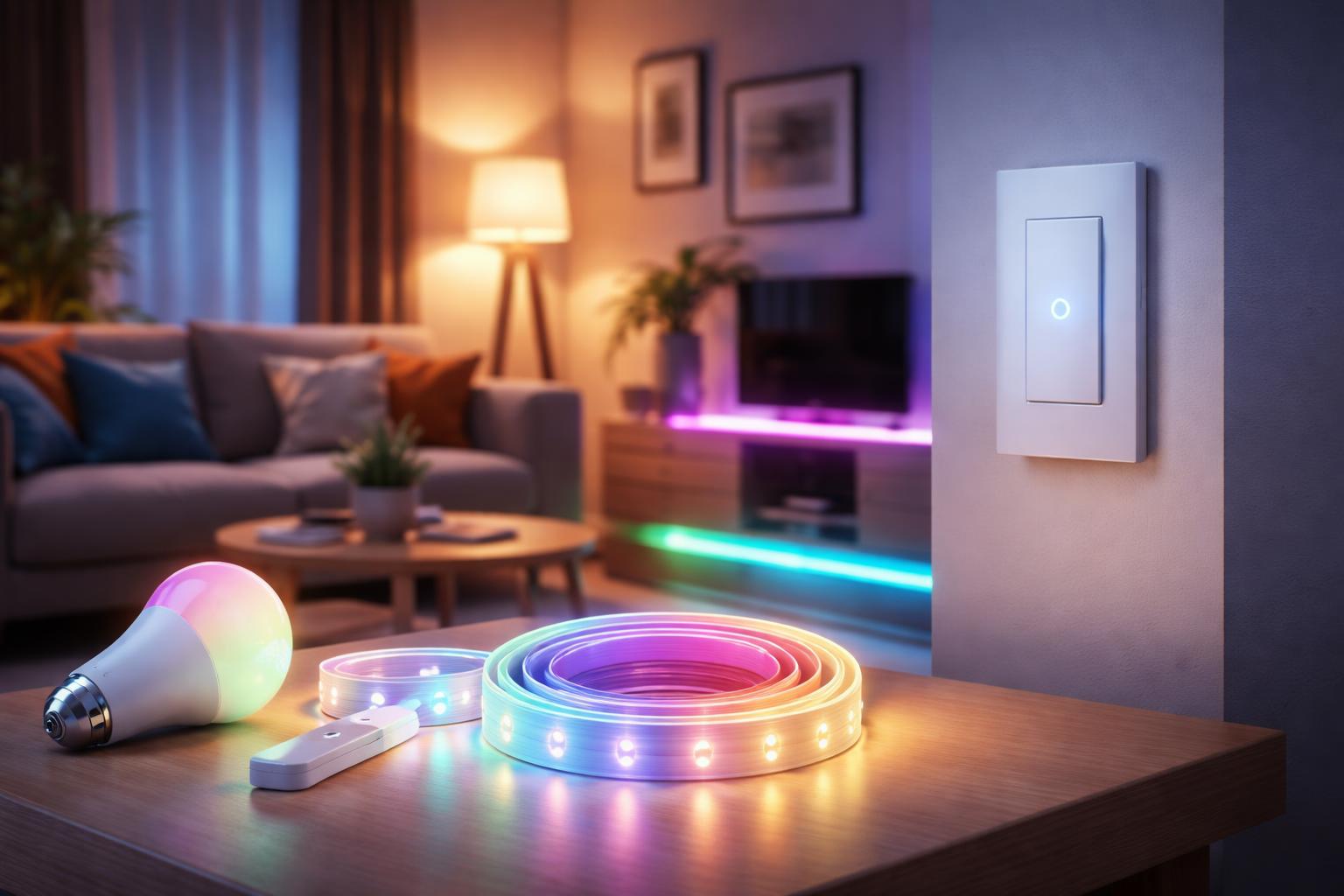
Transform Your Apartment Lighting: Smart Bulbs vs. Light Strips vs. Smart Switches
Deciding between smart bulbs, light strips, and smart switches to upgrade your apartment lighting hinges on your primary goal: do you want to easily upgrade existing fixtures for convenience, add vibrant accent lighting, or gain comprehensive control over all your current ‘dumb’ lights? For most renters seeking a quick, impactful, and portable upgrade to individual lamps and fixtures, smart bulbs are often the easiest entry point. However, smart light strips excel at creating stunning accent and mood lighting, while smart switches offer whole-room control over existing ceiling lights, provided your landlord allows installation or you opt for a plug-in solution.
Living in an apartment often means working within certain limitations, but that doesn’t mean you can’t embrace the convenience and ambiance of smart home technology. Smart lighting solutions offer a fantastic way to personalize your space, enhance your daily routines, and even save energy, all without making permanent modifications that might upset your landlord. From setting the perfect movie night mood to ensuring your lights turn off automatically when you leave, the right smart lighting can revolutionize your rental living experience.
Understanding Smart Lighting for Apartments
Smart lighting technology has evolved significantly, offering a range of products tailored for various needs and living situations. For apartment dwellers, specific considerations come into play: ease of installation and removal, impact on existing fixtures, and landlord policies. The beauty of modern smart lighting is its flexibility and ability to integrate smoothly into your life, often enhancing aesthetics and functionality without requiring extensive DIY skills or permanent changes.
Choosing the right type of smart lighting for your apartment involves weighing several factors. Do you want to control individual lamps, illuminate entire rooms, or add dynamic accent lighting? Are you looking for color-changing capabilities, dimming, or simply on/off control from your phone? Understanding the nuances of smart bulbs, light strips, and smart switches will help you make an informed decision that best suits your lifestyle and apartment setup.
Option 1: Smart Bulbs
Smart bulbs are arguably the most popular and simple entry point into smart lighting for apartment renters. They are designed to fit into existing light sockets, making them incredibly easy to install and move.
What Are Smart Bulbs?
Smart bulbs are LED light bulbs that contain built-in wireless technology, typically Wi-Fi or Bluetooth, allowing them to connect to your smart home ecosystem. This connectivity enables you to control them remotely via a smartphone app, voice commands (through a smart assistant like Alexa or Google Assistant), or even automate them based on schedules or other triggers. Many smart bulbs offer a spectrum of features, including dimming capabilities, color-changing options (RGB), tunable white light (from warm to cool), and scene pre-sets.
Pros of Smart Bulbs
* **Easy Installation:** The primary advantage is their plug-and-play nature. You simply screw them into any compatible light fixture – lamps, ceiling lights, recessed lighting – and pair them with your smart home hub or app. No wiring or tools are required beyond your hands.
* **Portability:** When you move apartments, you can easily unscrew your smart bulbs and take them with you, making them a wise, long-term investment.
* **Individual Control:** Each bulb can often be controlled independently, allowing for highly customized lighting zones within a single room. For example, you can have a reading lamp set to warm white while overhead lights are off, and a corner accent lamp glowing in a soft color.
* **Versatility:** Smart bulbs come in various shapes and sizes (A19, candelabra, floodlights, etc.) to fit almost any existing fixture. This means you can upgrade everything from your bedside lamp to your kitchen track lighting.
* **Ambiance Control:** With millions of colors and shades of white available from many brands, smart bulbs allow you to create virtually any mood or atmosphere, from vibrant party lighting to calming, soft illumination for winding down.
* **Energy Efficiency:** As LED bulbs, they consume significantly less energy than traditional incandescent bulbs and last much longer, potentially lowering your electricity bill.
* **Rental-Friendly:** Since they don’t require any modifications to your apartment’s wiring or fixtures, they are universally accepted by landlords.
For a reliable and feature-rich smart bulb experience, consider exploring options like Philips Hue Smart Bulbs.
Cons of Smart Bulbs
* **Cost for Whole-Room Coverage:** If you have many fixtures in a room (e.g., a living room with multiple recessed lights and lamps), the cost of replacing every bulb can add up quickly.
* **Switch Dependency:** The physical light switch for the fixture must remain in the “on” position for the smart bulb to receive power and function as a smart device. If someone accidentally flips the switch off, the bulb loses power and can’t be controlled remotely until it’s turned back on.
* **Potential Connectivity Issues:** Depending on your apartment’s Wi-Fi signal strength or the number of smart devices, you might encounter occasional connectivity glitches, though most modern systems are quite robust.
Ideal for:
Smart bulbs are perfect for renters who want to:
* Upgrade individual lamps and existing light fixtures.
* Easily add dimming, color, or tunable white light capabilities.
* Create specific moods or scenes in different areas of a room.
* Have a highly portable smart lighting solution.
* Avoid any complex installation.
Option 2: Smart Light Strips
Smart light strips offer a unique way to add accent lighting, backlighting, and dynamic visual effects to your apartment. They are incredibly versatile and can transform overlooked spaces into vibrant focal points.
What Are Smart Light Strips?
Smart light strips are flexible strips embedded with numerous LED lights, often featuring adhesive backing for easy installation. Like smart bulbs, they connect to your smart home network via Wi-Fi or Bluetooth and can be controlled through an app or voice commands. Many strips offer full RGB color control, tunable white light, and advanced features like “addressable LEDs” (RGBIC) which allow multiple colors to be displayed on a single strip simultaneously, creating stunning gradient effects.
Pros of Smart Light Strips
* **Dramatic Accent Lighting:** Light strips excel at creating indirect, ambient, or accent lighting. They are perfect for backlighting TVs, monitors, shelves, cabinets, beds, or even running along crown molding to wash a wall with color.
* **Versatile Placement:** Their flexible and adhesive design allows them to be installed in places where traditional bulbs or fixtures wouldn’t fit. You can curve them around corners, hide them under furniture, or highlight architectural features.
* **Dynamic Visuals:** With many offering RGBIC technology, smart light strips can produce incredible effects, from pulsing to music to subtle color shifts, adding a dynamic layer to your apartment’s aesthetic.
* **Easy, Non-Damaging Installation:** Most light strips come with strong, yet often removable, adhesive backing. This makes installation simple and non-permanent, which is crucial for renters. Many modern adhesives are designed to be removed without damaging paint or surfaces.
* **Portability:** Like smart bulbs, light strips can usually be peeled off (carefully!) and taken with you when you move, though re-adhesion might require fresh adhesive tape.
* **Energy Efficient:** Like other LED-based smart lighting, light strips are very energy efficient.
* **Rental-Friendly:** As long as you choose a strip with apartment-safe adhesive and don’t make any permanent changes, they are generally landlord-approved.
For advanced features and vibrant color control, consider smart light strips like the Govee RGBIC Smart Light Strips.
Cons of Smart Light Strips
* **Not for Primary Illumination:** While they add significant ambiance, light strips typically aren’t bright enough to serve as the sole source of general room lighting. They are best used as supplementary or accent lighting.
* **Visibility of Strip:** If not carefully placed, the strip itself can be visible, which might detract from the aesthetic. The best applications involve hiding the strip so only the glow is seen.
* **Requires Power Outlet:** Each light strip typically needs to be plugged into a wall outlet, which might limit placement options or require creative cable management.
* **Length Limitations:** While many strips can be extended or trimmed at specific points, there are practical limits to how long a single run can be without signal or power degradation.
Ideal for:
Smart light strips are ideal for renters who want to:
* Add dynamic accent or mood lighting.
* Backlight TVs, monitors, or furniture.
* Highlight architectural features or shelving.
* Create unique, customizable lighting effects.
* Install lighting in unconventional or hard-to-reach places.
Option 3: Smart Switches
Smart switches offer a different approach to smart lighting, focusing on controlling your existing “dumb” lights rather than replacing the bulbs themselves. This can be an appealing option for whole-room control or for making decorative fixtures smart without replacing specialty bulbs.
What Are Smart Switches?
Smart switches replace your apartment’s existing wall light switches or come as plug-in modules for lamps. In-wall smart switches allow you to control any light fixture connected to that switch – be it ceiling lights, wall sconces, or even switched outlets – from your smartphone or voice assistant. Plug-in smart switches (or smart dimmers) allow you to control individual lamps by plugging them into the module, which then plugs into the wall. They enable features like scheduling, remote on/off control, and dimming for standard, non-smart bulbs.
Pros of Smart Switches
* **Whole-Room Control:** An in-wall smart switch instantly makes an entire circuit of lights smart. This is ideal for controlling overhead lights in a living room or kitchen, allowing you to manage multiple bulbs with a single device.
* **Maintains Traditional Look:** If you have decorative light fixtures or special bulbs you don’t want to replace (like vintage Edison bulbs or non-standard shapes), a smart switch allows you to make them smart without changing their appearance.
* **Familiar Operation:** The physical switch still works like a regular light switch, which can be convenient for guests or family members who aren’t used to app or voice control.
* **Energy Savings:** Many smart switches offer dimming capabilities (even for non-dimmable bulbs if specified as such) and scheduling, which can significantly reduce energy consumption.
* **Centralized Control:** For apartment-wide control, having physical smart switches means everyone can intuitively turn lights on and off, while also retaining smart capabilities.
For compatible apartments, the Lutron Caséta Smart Dimmer Switch is a popular and reliable choice.
Cons of Smart Switches
* **Installation Complexity (In-Wall):** Replacing an existing in-wall switch requires some basic electrical knowledge and involves working with household wiring. If you’re not comfortable with this, you’ll need to hire an electrician. This is the biggest hurdle for renters.
* **Landlord Restrictions:** Many apartment leases explicitly prohibit tenants from altering electrical wiring or replacing fixtures. Always check your lease and, if in doubt, get written permission from your landlord before installing an in-wall smart switch.
* **Portability (In-Wall):** In-wall smart switches are not easily portable. While you can technically remove them when you move, you’d need to reinstall the original switch, and it’s a more involved process than unscrewing a bulb.
* **No Color Change:** Smart switches control the power to your existing bulbs. They cannot change the color of standard “dumb” bulbs; they only offer on/off and dimming functionality. For color control, you would still need smart bulbs.
* **Compatibility:** Ensure the smart switch is compatible with your existing wiring (e.g., requires a neutral wire in the switch box, which not all older apartments have).
Ideal for:
Smart switches are best for renters who:
* Want to control entire circuits of existing lights from a single point.
* Are allowed by their landlord to replace in-wall switches (or use plug-in versions for lamps).
* Prefer to keep their existing light fixtures and bulbs.
* Desire intuitive physical control alongside smart app/voice control.
* Need to make existing decorative or specialty lights smart.
Comparison Table: Smart Lighting Options at a Glance
To help you visualize the differences, here’s a quick comparison of smart bulbs, light strips, and smart switches for apartment living:
| Feature | Smart Bulbs | Smart Light Strips | Smart Switches (In-Wall) |
|---|---|---|---|
| **Installation** | Easiest (screw in) | Easy (adhesive) | Moderate to Difficult (electrical wiring) |
| **Landlord Friendly** | Extremely (no modifications) | Very (non-damaging adhesive) | Often Restricted (requires landlord permission) |
| **Primary Use** | General room lighting, lamps, task lighting | Accent lighting, backlighting, mood effects | Whole-room control of existing ceiling/fixture lights |
| **Portability** | Excellent (take them with you) | Good (can be removed, may need new adhesive) | Poor (involved removal/reinstallation) |
| **Color/Tunable White** | Yes (if supported by bulb) | Yes (if supported by strip) | No (controls ‘dumb’ bulbs, no color change) |
| **Dimming** | Yes | Yes | Yes (for compatible bulbs) |
| **Cost (per point of light)** | Moderate (per bulb) | Moderate (per strip) | Higher (per switch, controls multiple bulbs) |
| **Works with Existing Fixtures** | Yes (replaces bulb) | Adds to existing decor | Yes (controls existing bulbs) |
Factors to Consider When Choosing
Beyond the basic pros and cons, several personal and practical factors should guide your decision.
Your Apartment’s Wiring and Fixtures
Take a inventory of your apartment. What kind of fixtures do you have? Are there many lamps, or mostly built-in ceiling lights? Are the outlets controlled by wall switches? This will heavily influence whether smart bulbs (for existing fixtures), light strips (for accent areas), or smart switches (for wired lights) make the most sense. Always check for a neutral wire in your switch box if considering an in-wall smart switch, as many smart switches require one.
Desired Aesthetic and Functionality
What do you want your smart lighting to achieve?
* **General Illumination & Convenience:** Smart bulbs are great for making everyday lighting smart.
* **Mood & Ambiance:** Smart bulbs and light strips excel at creating atmospheric effects with color and dimming.
* **Accent & Decoration:** Light strips are unparalleled for highlighting features and adding a modern touch.
* **Whole-Room Control:** If you want to control all your overhead lights with one command and your landlord allows, smart switches are the answer.
Installation Comfort Level
Are you comfortable with basic DIY?
* **Smart Bulbs:** Easiest, anyone can do it.
* **Smart Light Strips:** Easy, just peel and stick.
* **Smart Switches (In-Wall):** Requires comfort with electrical work or hiring a professional, and landlord permission. Plug-in smart switches are as easy as plugging in a lamp.
Budget and Scalability
While we aren’t discussing prices, consider the overall investment. Smart bulbs can add up if you need many. Light strips might be a one-time purchase for a specific area. Smart switches can be more costly upfront per unit but might control more lights. Think about how you might want to expand your smart lighting in the future.
Smart Home Ecosystem Compatibility
Ensure your chosen smart lighting integrates with your existing or planned smart home ecosystem (e.g., Amazon Alexa, Google Home, Apple HomeKit). Most major brands offer broad compatibility, but it’s always good to double-check. Using a consistent platform simplifies control and automation.
Making the Right Choice for Your Apartment
Often, the best solution isn’t one type of smart lighting, but a combination. Many renters start with Philips Hue Smart Bulbs for their lamps and main light fixtures, appreciating their ease of use and portability. They might then add smart light strips behind a TV or under cabinets to enhance specific areas. If landlord permission is granted and you’re comfortable with the installation, a smart switch could tie together the overhead lighting in a main living space.
Start small, perhaps with a few smart bulbs in your most used lamps, and expand as you discover what works best for your space and lifestyle. The modular nature of smart lighting makes it easy to experiment and build your ideal smart home environment piece by piece.
FAQ: Smart Lighting for Renters
Q1: Can I install in-wall smart switches in a rental apartment?
You should always check your lease agreement and obtain explicit written permission from your landlord before installing any in-wall smart switches. Such installations typically involve electrical wiring and are considered permanent modifications. Plug-in smart switches or smart outlets are a much safer, rental-friendly alternative for controlling individual lamps.
Q2: Will smart bulbs work with a dimmer switch?
It depends on the smart bulb and the dimmer switch. Generally, it’s not recommended to use smart dimmable bulbs with traditional in-wall dimmer switches. Smart bulbs are designed to be dimmed through their app or smart home system, and a traditional dimmer can interfere with their internal electronics, causing flickering or damage. It’s best to leave the traditional switch in the “on” position and control dimming via the smart features.
Q3: How many smart light strips do I need for a room?
This depends on the size of the room and your intended use. For accent lighting behind a TV or under a small shelf, a single strip might suffice. For larger areas like under kitchen cabinets or around an entire room’s perimeter for ambient lighting, you may need multiple strips connected together or individual strips strategically placed. Always measure your space before purchasing.
Q4: Do smart lights save energy?
Yes, smart lights, especially those using LED technology (which most are), are inherently more energy-efficient than incandescent bulbs. Beyond that, their smart features like scheduling, motion detection, and remote turn-off capabilities can help reduce wasted electricity by ensuring lights are only on when needed, and often at lower brightness settings.
Q5: What’s the easiest smart lighting option for a beginner?
Smart bulbs are hands down the easiest option for beginners in an apartment. They simply screw into existing fixtures, require no wiring, and are highly portable. They offer a simple, low-commitment way to experience the benefits of smart lighting immediately.
Conclusion
Transforming your apartment lighting with smart technology is an accessible and rewarding endeavor for any renter. Whether you opt for the simplicity and portability of smart bulbs, the dynamic ambiance of light strips, or the comprehensive control of smart switches (where permitted), each option brings unique advantages. Consider your specific needs, your apartment’s layout, and your landlord’s policies to create a personalized, convenient, and energy-efficient lighting setup that truly enhances your living space. Start small, explore the possibilities, and enjoy the brilliant future of your smart home.