
Disclosure: This article contains affiliate links. As an Amazon Associate, we earn from qualifying purchases at no extra cost to you.
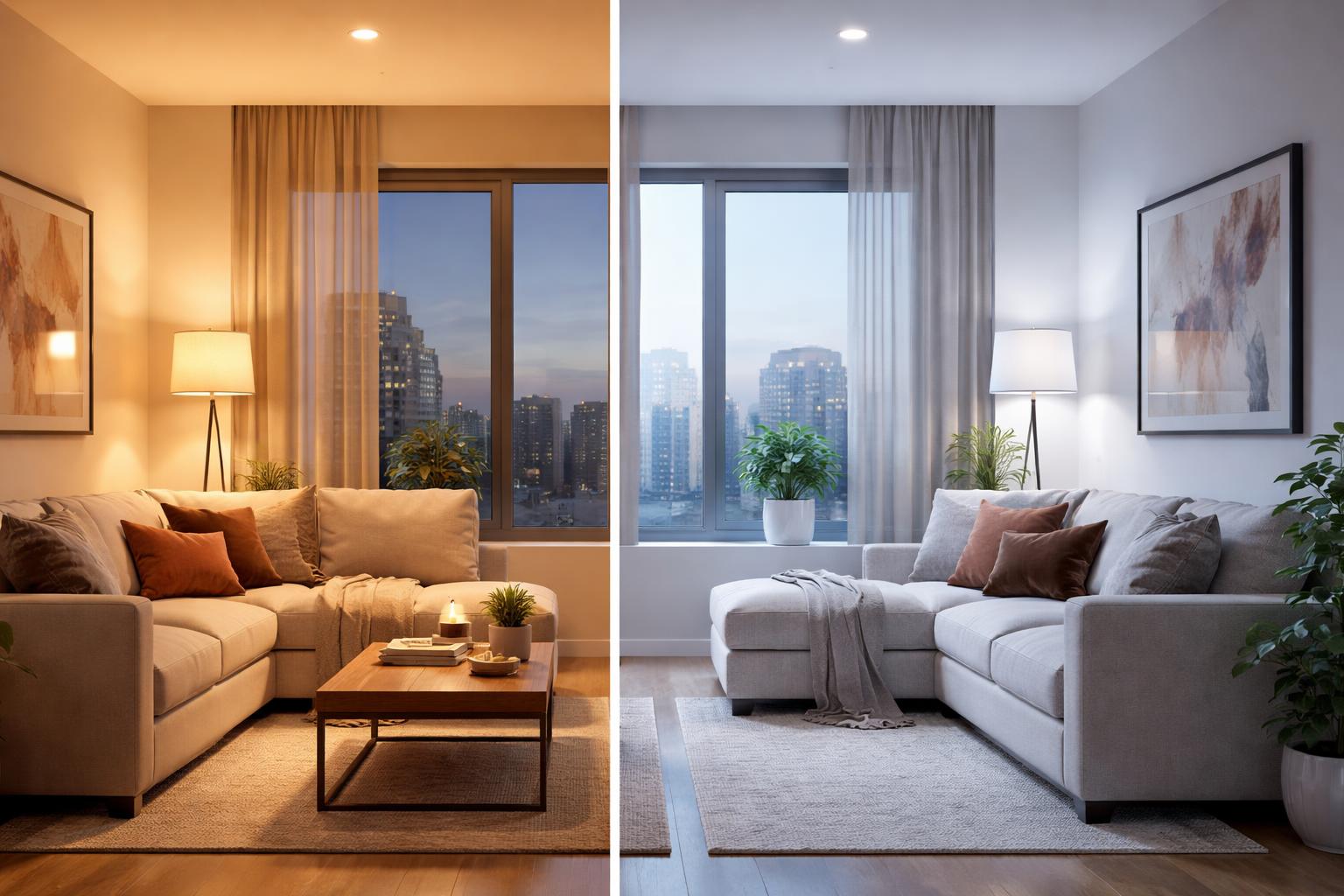
Quick Answer: For living rooms, go with 2700K — it’s warmer, more relaxing, and easier on the eyes at night. Use 5000K for kitchens, bathrooms, and home offices. Want both? A tunable smart bulb gives you full flexibility.
Understanding Color Temperature (CCT)
Before diving into the specifics of 2700K and 5000K, it’s essential to understand what color temperature means in the context of lighting. Color temperature, measured in Kelvin (K), describes the warmth or coolness of the light emitted by a bulb. It’s a spectrum, not just a binary choice.
* **Lower Kelvin values (e.g., 2000K-3000K)** produce “warm” light, which appears more yellow or orange, similar to candlelight or traditional incandescent bulbs. This light is often associated with comfort, relaxation, and intimacy.
* **Higher Kelvin values (e.g., 4000K-6500K)** produce “cool” light, which appears more bluish-white, mimicking natural daylight. This light is typically associated with alertness, focus, and clarity.
The choice of color temperature significantly impacts the perception of a room, influencing mood, perceived cleanliness, and even how colors of your decor appear.
The Allure of 2700K: Warm White Light
2700K is a classic choice for residential lighting, particularly in living spaces. It emits a soft, slightly yellowish-white light that many find incredibly comforting and inviting.
* **Characteristics:** Think of the gentle glow of an old-fashioned incandescent bulb or the warm light of a sunset. 2700K light is low on the Kelvin scale, giving it a distinct yellowish hue that creates a cozy and intimate ambiance. It’s designed to make a space feel welcoming and relaxed.
* **Benefits for an Apartment Living Room:**
* **Cozy Ambiance:** Perfect for unwinding after a long day, reading a book, or enjoying a quiet evening.
* **Relaxation:** Its warm tones are less stimulating than cooler lights, promoting a sense of calm and helping your body prepare for rest.
* **Enhanced Warm Decor:** If your living room features warm colors, wooden furniture, or rich fabrics, 2700K light will accentuate these tones beautifully, making them appear richer and more vibrant.
* **Soft on the Eyes:** The mellow light is generally easier on the eyes, especially in the evenings, reducing strain.
* **Intimacy:** It creates an intimate setting, ideal for conversations and entertaining close friends, making the room feel more personable.
* **Ideal Uses:** While superb for living rooms, 2700K is also excellent for bedrooms, dining rooms, and other areas where relaxation and warmth are priorities. It helps to define a space as a personal sanctuary.
In an apartment, where space can sometimes feel confined, 2700K light can help make the living room feel larger and more open by softening the edges and creating a gentle, enveloping glow.
The Clarity of 5000K: Cool White/Daylight
On the other end of the spectrum, 5000K emits a much brighter, crisper light that closely mimics natural daylight at noon. It’s often referred to as “daylight” white.
* **Characteristics:** This light has a noticeable blue tint compared to 2700K. It’s vibrant, sharp, and illuminates objects with great clarity, allowing colors to appear truer to their natural state.
* **Benefits (Though Less Common for Primary Living Room Use):**
* **Increased Alertness and Focus:** The bright, cool light can boost concentration and energy levels, making it suitable for tasks that require attention to detail.
* **True Color Rendering:** Artists, crafters, or anyone needing to see colors accurately will appreciate 5000K light, as it provides excellent color rendering, reducing color distortion.
* **Modern Aesthetic:** If your living room boasts a minimalist, modern, or industrial design with cool color palettes, 5000K can complement this aesthetic, making the space feel clean and contemporary.
* **Visibility for Tasks:** While not ideal for general ambiance, if your living room doubles as a workspace or hobby area, 5000K can provide the necessary brightness for intricate tasks.
* **Energizing Effect:** Can be beneficial for waking up in the morning or for daytime activities where you need to feel more alert.
* **Ideal Uses:** 5000K is typically preferred in kitchens, bathrooms, home offices, laundry rooms, garages, and commercial settings where high visibility and an energizing atmosphere are paramount.
For an apartment living room, relying solely on 5000K might make the space feel sterile, overly bright, or less inviting, particularly in the evenings when you’re trying to wind down.
Apartment Living Room Dynamics: Which Kelvin Reigns Supreme?
The “better” choice isn’t just about the numbers; it’s about how the light interacts with your specific living space and lifestyle. An apartment living room presents unique considerations.
Size and Layout of Your Apartment Living Room
Apartment living rooms can range from compact studios to spacious open-concept areas.
* **Smaller Living Rooms:** A warmer light like 2700K can make a small room feel more intimate and inviting, softening boundaries. Too much bright, cool light in a small space can feel overwhelming and clinical.
* **Larger, Open-Concept Spaces:** In a larger apartment or an open-plan layout where the living room blends with a kitchen or dining area, a warmer light still often works best for the living zone itself. However, you might consider layering different color temperatures (e.g., warmer in the seating area, slightly cooler in a nearby reading nook) if you have the flexibility.
* **Natural Light Availability:** If your living room receives abundant natural light during the day, your artificial lighting choices become more critical for the evenings. 2700K can provide a pleasant contrast as daylight fades, creating a transition to a cozy night setting. If your living room is naturally dark, a slightly brighter but still warm light (perhaps 3000K) might be considered, but 2700K still maintains that essential warmth.
Activities and Moods
What do you primarily do in your living room?
* **Relaxing & Entertainment:** Watching TV, listening to music, unwinding after work, or casual conversations. These activities thrive under the soft, comforting glow of 2700K.
* **Reading & Hobbies:** If you frequently read or engage in detailed hobbies in your living room, specific task lighting with a slightly cooler temperature (perhaps 3500K-4000K) might be beneficial, but this should be supplementary to the main ambient lighting. Using 5000K for general ambient light would be too harsh for relaxation.
* **Entertaining:** For social gatherings, 2700K creates a welcoming and convivial atmosphere that encourages conversation and comfort.
Decor and Color Scheme
Your interior design plays a significant role.
* **Warm Tones:** Decor featuring reds, oranges, yellows, browns, and natural wood finishes will be beautifully enhanced and brought to life by 2700K light, making the space feel cohesive and rich.
* **Cool Tones:** Blues, greens, grays, and whites in your decor might appear slightly duller under very warm light. However, 2700K still provides a pleasant contrast, preventing a cold, stark feeling. If your decor is predominantly cool and modern, and you want to lean into that aesthetic, 3000K or 3500K might be a compromise, but 5000K generally pushes too far into clinical territory for a living room.
The Circadian Rhythm Connection
Our bodies are naturally attuned to the light-dark cycle. Exposure to bright, cool light (like 5000K) in the evening can suppress melatonin production, making it harder to fall asleep. Conversely, warm, dim light (like 2700K) signals to our bodies that it’s time to wind down. For a living room, especially in the hours leading up to bedtime, 2700K is much more conducive to healthy sleep patterns.
The Ultimate Solution: Smart Bulbs with Tunable White
Given the varied activities and moods a living room can encompass, why choose just one color temperature when you can have them all? This is where smart bulbs with tunable white technology shine, offering unparalleled flexibility.
These innovative bulbs allow you to adjust the color temperature from a very warm 2200K all the way up to a crisp 6500K (and sometimes even offer full-color RGB options). This means you can:
* **Start Your Day Bright:** Wake up to a bright, energizing 4000K-5000K light in the morning.
* **Transition to Comfort:** Gradually shift to a comfortable 3000K during the day.
* **Wind Down in Warmth:** Settle into a super cozy 2700K or even warmer 2200K in the evening, perfect for relaxation and preparing for sleep.
* **Match Any Mood or Activity:** Need bright light for a quick clean-up? Switch to 5000K. Hosting a dinner party? Go for a warm, inviting 2700K. Watching a movie? Dim it down to a soft, warm glow.
Brands like Philips Hue and TP-Link Kasa Smart Bulbs offer excellent tunable white options, often controllable via an app on your smartphone or through voice commands with smart assistants like Google Home Smart Light integration. This level of customization allows your lighting to adapt to your life, rather than forcing you to adapt to your lighting.
2700K vs 5000K: A Quick Comparison
Here’s a concise overview to help visualize the differences between these two common color temperatures:
| Feature | 2700K (Warm White) | 5000K (Daylight) |
|---|---|---|
| Appearance | Soft, yellowish-white, warm glow | Bright, bluish-white, crisp |
| Ambiance | Cozy, inviting, intimate, relaxing | Energizing, clinical, modern, alert |
| Mood Effect | Promotes relaxation, comfort, sleep | Enhances focus, alertness, productivity |
| Best For | Living rooms, bedrooms, dining rooms, relaxation areas | Kitchens, bathrooms, offices, task lighting, utility areas |
| Decor Impact | Enhances warm tones, woods; softens cool colors | Enhances cool tones, metallics; can mute warm colors |
| Time of Day | Evenings, night-time, overall ambient light | Daytime, task-specific lighting |
Making the Best Choice for YOUR Living Room
Ultimately, the best color temperature is subjective. Here are some tips for making your personal decision:
1. **Consider Your Primary Use:** If your living room is mainly for relaxing, watching TV, and unwinding, 2700K is your go-to. If it’s a multi-functional space where you occasionally need to work or engage in detailed tasks, smart tunable bulbs are invaluable.
2. **Experiment (If Possible):** If you’re unsure, try purchasing a single bulb of both 2700K and 5000K (or, even better, a tunable white smart bulb) and test them in your space at different times of the day. This direct comparison can be very revealing.
3. **Layer Your Lighting:** A well-lit living room rarely relies on a single light source. Combine overhead ambient lighting with task lighting (e.g., a floor lamp for reading) and accent lighting (e.g., picture lights, sconces). You can use different color temperatures for different layers to achieve versatility. For instance, your main ambient light could be 2700K, while a reading lamp might be 3000K.
4. **Embrace Smart Lighting:** As highlighted, smart bulbs offer the ultimate flexibility. They allow you to dynamically change the lighting to match any activity, time of day, or mood, ensuring your apartment living room is always perfectly lit.
Frequently Asked Questions (FAQ)
Q: Is 2700K or 5000K better overall?
It depends on the room. 2700K (warm white) is better for living rooms, bedrooms, and dining areas — anywhere you want a relaxed, cozy feel. 5000K (daylight) is better for kitchens, bathrooms, garages, and workspaces where you need brightness and clarity. For a living room specifically, 2700K wins.
Q: Can I mix 2700K and 5000K bulbs in the same room?
While technically possible, mixing vastly different color temperatures like 2700K and 5000K within the same visual field or in prominent fixtures in a living room is generally not recommended. It can create a jarring and unbalanced look, making the space feel incoherent rather than harmonious. If you want to incorporate different light temperatures, it’s best to do so subtly through layered lighting, perhaps using 5000K for very specific, concealed task lighting in a multi-functional space, while keeping the main ambient and decorative lighting at 2700K.
Q: Does color temperature affect energy consumption?
No, the color temperature (Kelvin) of an LED bulb does not directly affect its energy consumption (watts). A 2700K LED bulb and a 5000K LED bulb of the same wattage and lumen output will consume roughly the same amount of electricity. Energy consumption is primarily determined by the wattage and efficiency of the bulb, not the color of the light it produces.
Q: Are there smart bulbs that offer both 2700K and 5000K?
Absolutely, yes! This is one of the key advantages of modern smart lighting. Many smart bulbs, often referred to as “tunable white” bulbs, allow you to adjust the color temperature smoothly across a wide range, typically from very warm (around 2200K) to very cool (up to 6500K). This flexibility means you can have the cozy ambiance of 2700K and the bright clarity of 5000K from the same bulb, controlled via an app or voice commands.
Q: What about brighter lights, like 6500K?
6500K is even cooler and bluer than 5000K, closely mimicking overcast daylight. While excellent for tasks requiring extreme clarity, such as examining fine details or for specific therapeutic lighting (e.g., SAD lamps), it is almost universally too harsh and sterile for an apartment living room’s general ambient lighting. It can make a room feel cold, unwelcoming, and can disrupt natural sleep patterns if used in the evenings. It’s best reserved for very specific task-oriented or utility areas.
Q: How many lumens should I aim for in my living room?
While color temperature influences mood, lumens dictate brightness. For a living room, a general guideline is to aim for approximately 1,500 to 3,000 lumens in total, depending on the room’s size, ceiling height, and desired brightness. This total can be achieved by combining several light fixtures (e.g., an overhead fixture, floor lamps, table lamps). A good starting point might be individual bulbs around 800-1000 lumens (equivalent to an old 60W incandescent) for main fixtures, and less for accent lighting. Smart bulbs often allow you to dim the light, giving you even more control over the perceived brightness.
Final Verdict
For most apartment living rooms, especially those dedicated to comfort and relaxation, 2700K (Warm White) is the superior choice for ambient lighting, fostering a cozy, inviting atmosphere. While 5000K (Daylight) offers clarity and an energizing feel, it often proves too stark for a residential living space. However, the modern solution for ultimate adaptability is to invest in smart bulbs with tunable white capabilities. These allow you to smoothly transition between various color temperatures, ensuring your apartment living room is perfectly illuminated for every activity, mood, and time of day, making it a truly versatile and comfortable haven.